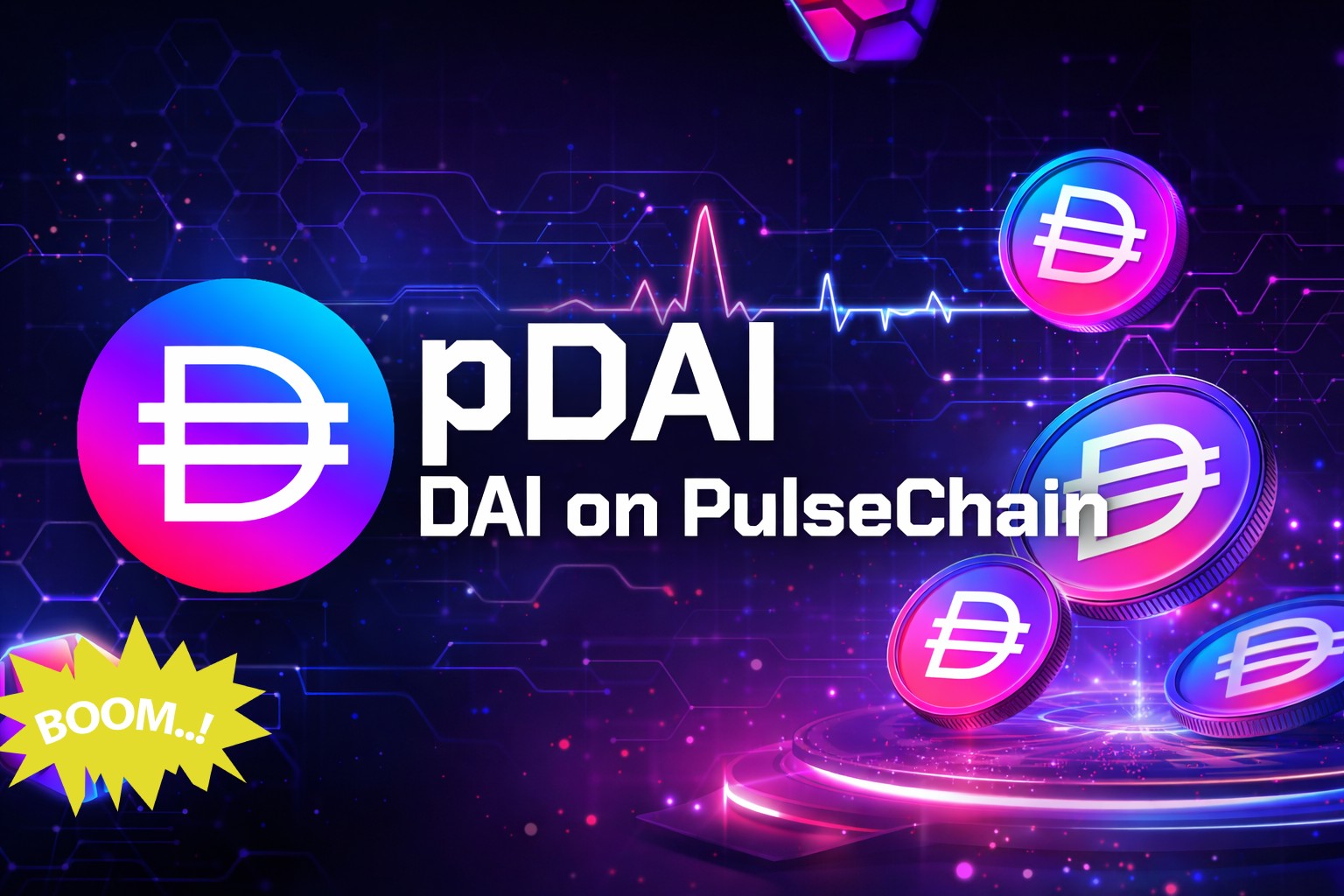
Most people land on PulseChain looking for the usual stuff: fast swaps, cheap gas, DeFi that doesn’t cost a small fortune in fees. pdai on pulsechain here.
“Is this DAI… like real $1 DAI?”
Disclaimer: This article is informational only not financial or legal advice. Crypto is risky. Always verify contract addresses and understand what you’re interacting with before swapping, bridging, or providing liquidity.
First: Two “DAIs” exist on PulseChain and mixing them up is how people get burned
On PulseChain, “DAI” can mean two completely different assets.
1) pDAI (the forked DAI on PulseChain)
This is the state-copied snapshot of Ethereum’s DAI contract that was replicated onto PulseChain at genesis.
- What it is: the forked DAI contract on PulseChain
- Common label: “pDAI” / “DAI on PulseChain”
- Reality today: it does not maintain a $1 peg
- Price: market-driven it trades where buyers and sellers agree
Canonical Ethereum DAI contract address (the well-known one):0x6B175474E89094C44Da98b954EedeAC495271d0F
(On PulseChain, you’ll see the forked version associated with that same address format but on the PulseChain network.)
2) Bridged DAI (the pegged asset)
This is the version people usually expect DAI bridged from Ethereum.
- What it is: a bridged representation of Ethereum DAI
- Typical behavior: trades near $1.00 (because it’s backed 1:1 by Ethereum DAI)
- Use case: “stablecoin DAI” for everyday DeFi pricing and accounting
If you want stable “$1 DAI today,” you’re usually looking for Bridged DAI.
If you’re here for the sovereignty mission, the experiment, and the long-term thesis that’s pDAI.
So why does pDAI exist and why does it matter?
Because pDAI is about something bigger than convenience.
pDAI is the sovereignty-first stablecoin narrative on PulseChain
In a world where “stablecoin” often means “issuer-controlled,” pDAI represents the opposite direction:
- self-custody
- on-chain ownership
- no centralized issuer standing above the asset
- a culture that values permissionless finance
This is why pDAI resonates. It’s not trying to be the easiest product. It’s trying to be the most sovereign.
“Unconfiscatable” what we mean (and what we don’t)
At the token level, pDAI isn’t built around a centralized issuer who can just decide to freeze you because they got a phone call.
But we’ll be real with you: censorship can still happen at the edges
front-ends can block access, infrastructure can fail, and UIs can comply with regulations.
The difference is: if you self-custody, and the asset lives on-chain, you’re not depending on an issuer’s permission to hold it.
That’s the heart of the pDAI philosophy.
The $1 Mission: A target worth fighting for not a guaranteed peg
Let’s address the elephant in the room.
Yes: the long-term mission many pDAI supporters care about is a return toward $1.00.
But here’s the honest framing:
- pDAI is not pegged by default
- there’s no built-in magic that forces price to $1
- getting closer to $1 is something the market must choose through adoption, liquidity depth, utility, and ecosystem momentum
So when we say “$1 mission,” what we mean is:
A community-driven target achieved through real demand, real usage, and real liquidity not promises.
This is exactly why pDAI is interesting: it’s not a button. It’s a movement.
What can you do with pDAI today?
Because pDAI trades freely, its real utility is tied to PulseChain’s DeFi engine:
Trade it
pDAI is actively traded on PulseChain DEXs, where the market discovers price.
Provide liquidity
Some users provide liquidity in pDAI pairs as part of their PulseChain strategy (with the usual LP risks).
Hold the thesis
Others hold pDAI because they believe in the long-term story: sovereignty-first money on a high-throughput chain, with a $1 target as the north star.
How to verify you’ve got the right asset (seriously do this every time)
This is where people mess up, so keep it simple:
- Confirm the network (PulseChain vs Ethereum)
- Check the contract address (forked pDAI ≠ bridged DAI)
- Use a block explorer (wallet labels are often wrong)
- Verify the pair before swapping (names can be misleading)
- Never rely on ticker alone (“DAI” is not precise on PulseChain)
If you’re using pdai.net as your home base, this is your edge: teach verification, and you earn trust.
FAQs
If pDAI isn’t $1, why call it pDAI at all?
Because it originates from the DAI contract snapshot. The name is historical the mission is forward-looking.
Can I still use “real” $1 DAI on PulseChain?
Yes via Bridged DAI. Just verify the contract before swapping.
Is pDAI “outside regulation”?
Nobody can promise that. The stronger claim is simpler: pDAI is non-custodial and on-chain, which can change how enforcement works compared to issuer-controlled products. This is not legal advice.
Is pDAI a safe investment?
pDAI is speculative. It’s about a thesis, not a guaranteed peg. Only participate if you understand the risks.
The takeaway
Bridged DAI is for stability today.
pDAI is for sovereignty and the long-term $1 mission.
pDAI isn’t here to be the easiest narrative in crypto. It’s here to be the clearest one:
self-custody, unstoppable ownership, and a market-driven journey toward $1.
Call to action
If you’re new here, start with the basics:
- Verify the contract you’re interacting with (forked vs bridged)
- Learn the difference once, and you’ll never get confused again
- Bookmark pdai.net and follow the blog we’ll keep the signal high and the hype honest
Conclusion
pDAI isn’t here to pretend. It’s here to build: a sovereignty-first asset on PulseChain with a long-term $1 mission driven by adoption, liquidity, and real usage. If you want stability today, use Bridged DAI. If you want the thesis and the upside that comes with it pDAI is the lane.